

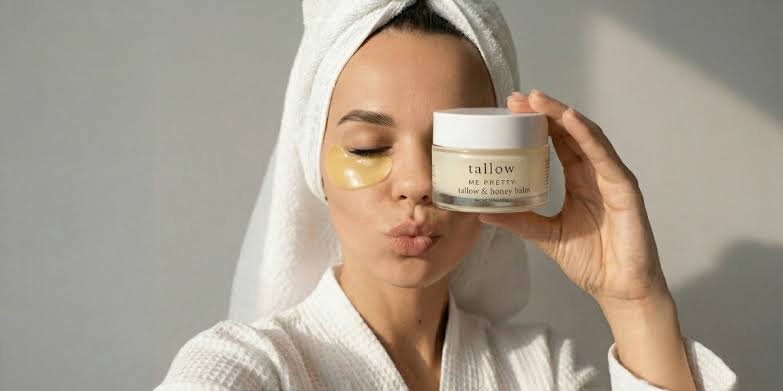
Long before serums had eleven-step routines and ingredient lists nobody could pronounce, people moisturised their skin with what was on hand: rendered animal fat and honey from the hive. That combination has quietly become one of the more interesting stories in skincare over the past couple of years, with the broader tallow skincare category reaching an estimated $277 million globally in 2025 and the hashtag #tallowskincare passing 800 million views on TikTok. But virality doesn’t automatically mean efficacy. So what does the actual science say about why tallow and honey, specifically together, have earned this kind of staying power?
What’s Actually in Tallow That’s Good for Skin
Tallow, rendered fat from grass-fed cattle, owes most of its skincare reputation to its fatty acid profile. It’s rich in oleic acid, stearic acid, and palmitic acid, a blend that closely mirrors the composition of lipids naturally found in human skin. That similarity is more than a coincidence of chemistry; it’s the mechanical reason tallow tends to integrate into the skin’s own barrier rather than simply sitting on the surface the way some purely synthetic occlusives do.
Beyond fatty acids, tallow carries trace amounts of fat-soluble vitamins A, D, E, K and B12. Researchers are still working out exactly how well these are absorbed through topical application, so it’s worth being cautious about overstating that particular benefit. What’s better established is tallow’s role as a moisture barrier support, helping reduce water loss from the skin and soften rough, dry patches, in much the same functional category as coconut oil or shea butter, just with a fatty acid ratio that happens to line up unusually closely with our own.
Honey’s Long, Well-Documented History as a Skin Ingredient
Honey’s skincare credentials are on considerably firmer scientific ground, backed by a genuinely large body of research, including clinical use in wound care. Honey is a natural humectant, meaning it draws and holds moisture rather than simply sealing it in, which is a meaningfully different mechanism to an occlusive fat like tallow. That’s part of why the two pair so well: one draws moisture in, the other helps keep it from escaping.
Honey also has documented antibacterial properties, driven by a combination of low water activity, a naturally acidic pH, and the slow release of hydrogen peroxide through an enzymatic process as it interacts with skin. This isn’t a fringe claim; medical-grade honey dressings are used clinically for wound and burn care precisely because of this antimicrobial activity, alongside its ability to support a moist healing environment. Layered on top of that, honey contains flavonoids and phenolic compounds with antioxidant properties, which help address the kind of oxidative stress associated with environmental skin damage over time.
Why Tallow and Honey Work Well Together
Individually, both ingredients have a reasonable evidence base. Combined, they address two different, complementary jobs that skincare needs to do at once: sealing moisture in and drawing moisture in from the surrounding environment. Tallow’s occlusive, barrier-mimicking fat structure locks hydration in place, while honey’s humectant pull keeps drawing moisture toward the skin, and its antibacterial and antioxidant properties add a layer of support that pure fat alone doesn’t offer.
There’s also a practical formulation advantage worth noting. Because both tallow and honey are naturally low in water content, a tallow and honey balm formulated without added water tends to be inherently less hospitable to bacterial growth than a conventional water-based cream, which is part of why traditional fat-and-honey preparations have such a long history as stable, shelf-safe skin remedies well before refrigeration or synthetic preservatives existed.
The Ancestral Skincare Movement Behind This Comeback
None of this is happening in a vacuum. Tallow and honey’s resurgence sits squarely inside a broader “ancestral skincare” and clean beauty movement gaining real traction in 2026, driven by two distinct but overlapping groups: younger consumers drawn to the idea of using ingredients their great-grandparents would recognise, and an older, more ingredient-literate cohort specifically seeking to avoid synthetic preservatives, seed oils, and long, unpronounceable ingredient lists.
Part of what’s kept this trend from fading the way many skincare fads do is that it’s largely grown from small producers and DIY communities rather than large corporate marketing pushes, and the online conversation around it tends to be substantive rather than passive, people genuinely comparing sourcing, rendering methods, and formulations rather than just watching a trend go by. That kind of engaged, detail-oriented community tends to build more durable interest than a purely aesthetic trend.
What to Look for When Trying Tallow and Honey Balm Products
If the science has you curious enough to try it, sourcing and formulation matter more in this category than almost any other skincare purchase, precisely because tallow and honey products vary so widely in quality. Look for full traceability back to the source, ideally grass-fed and pasture-raised for the tallow, and raw or minimally processed honey rather than heavily refined versions that lose much of their antibacterial and antioxidant activity in processing.
A genuinely minimal ingredient list is a good sign in this category specifically, since it usually means you’re not looking at a product padded out with fillers, synthetic fragrance, or preservatives designed to compensate for a poorly made base. Brands like tallow and honey balm from Tallow Balm Shop are a useful example of what that looks like in practice: small-batch, traceable sourcing, and nothing in the jar that isn’t doing a specific job for your skin. As with any new skincare ingredient, particularly one this rich and occlusive, patch testing on a small area first is worth doing before applying it more broadly, especially if you have oily or acne-prone skin.
The Takeaway
Tallow and honey aren’t a miracle cure dressed up in ancestral branding, but they’re also not just a TikTok fad riding on nostalgia. The fatty acid science behind tallow and the well-documented humectant and antibacterial properties of honey give this pairing a genuinely reasonable case for a place in a modern skincare routine, provided the sourcing and formulation are taken as seriously as the ingredients themselves.
